

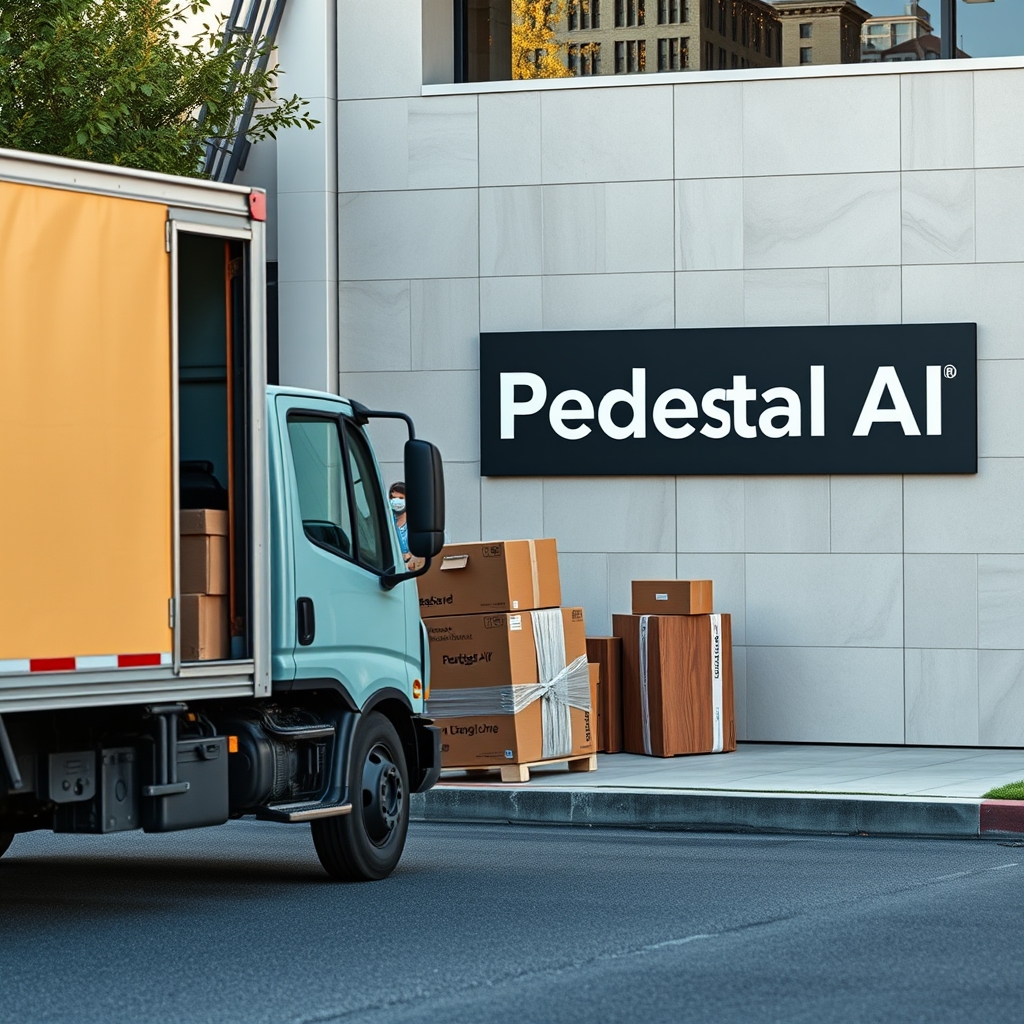
Pedestal AI has emerged from stealth with $4.7 million in seed funding, backing its effort to use AI agents to make delivery supply chains more reliable. The startup is targeting operational friction across shipping and delivery, where missed appointments and incomplete customer information can disrupt a shipment’s final leg. It says it is already working with Fortune 500 companies and some of the world’s largest shipping firms.
The round was led by Eclipse, with participation from RRE, Converge VC, Timescale Ventures and VitalStage. Pedestal plans to use the capital to expand product and engineering work, build out its marketing organization and support additional deployments. The announcement puts the company among a growing set of startups applying AI to logistics, but its initial focus is on tasks that can directly affect whether a delivery is completed successfully.
Agents target a persistent delivery problem
One deployment offers a concrete example of the company’s approach. For a major furniture company, Pedestal says it reduced missed deliveries by 20% by using agents to handle parts of the pre-delivery work that would otherwise fall to drivers. The system calls customers about 30 minutes before a scheduled delivery to gather special instructions. If the call does not connect, a separate system sends a text message instead.
The process is designed to address a practical source of delivery failure: drivers may need information from customers before arriving, while that information can be difficult to collect consistently. A call or message can surface instructions that affect the delivery, and the fallback text provides another opportunity to reach the customer. Pedestal’s reported result concerns missed deliveries for this particular client; the company has not described it as a result that applies uniformly across its deployments.
The work also generated data about where friction arose in the delivery process. That information can help the company identify patterns and adjust the workflow, although the announcement does not detail the specific findings or changes made from those data. CEO Raj Aggarwal has pointed to the difficulty of working with information spread across legacy systems and changing over time. In that setting, an agent’s role is not simply to place a call, but to help carry out a repeatable task amid fragmented operational information.
Funding supports product and deployment growth
Supply-chain operations commonly involve information passing among different organizations and systems, making coordination a central challenge. A delivery workflow may depend on accurate customer details and timely updates, while the underlying data can be inconsistent or distributed across older software. Aggarwal told TechCrunch that this messy, shifting and dispersed information is what makes the problem difficult. Pedestal’s pitch is that purpose-built agents can take on defined tasks within that environment and help businesses act on operational data.
That focus also connects the product to measurable business outcomes. A missed delivery can mean wasted effort and added coordination, while a successful delivery can complete the service a customer expects. In Pedestal’s example, the company links its intervention to a 20% reduction in missed deliveries for one furniture business. The result gives a tangible measure for that deployment, but companies evaluating similar tools would still need to assess whether the workflow, data quality and operating conditions at their own businesses produce comparable value.
A growing field, with outcomes still to prove
Pedestal is entering a supply-chain technology market that has drawn founders with experience in other technology sectors. Atomic, founded by Tesla alumni, emerged from stealth in 2025 with a focus on streamlining inventory. Loop, launched by Uber alumni, is focused on predictive analytics. Those companies address different parts of supply-chain operations, illustrating how startups are approaching the broader field through specific problems rather than a single all-purpose system.
Aggarwal has argued that delivery work is well suited to reinforcement learning because it happens at high volume and has outcomes that can be measured. That can give systems feedback on which approaches are working, though it does not remove the need for reliable data, careful deployment or oversight of customer-facing communications. Pedestal’s funding will give it resources to develop its product and support more deployments; whether its approach can deliver consistent benefits across different clients will depend on how it performs in those varied operating environments.