

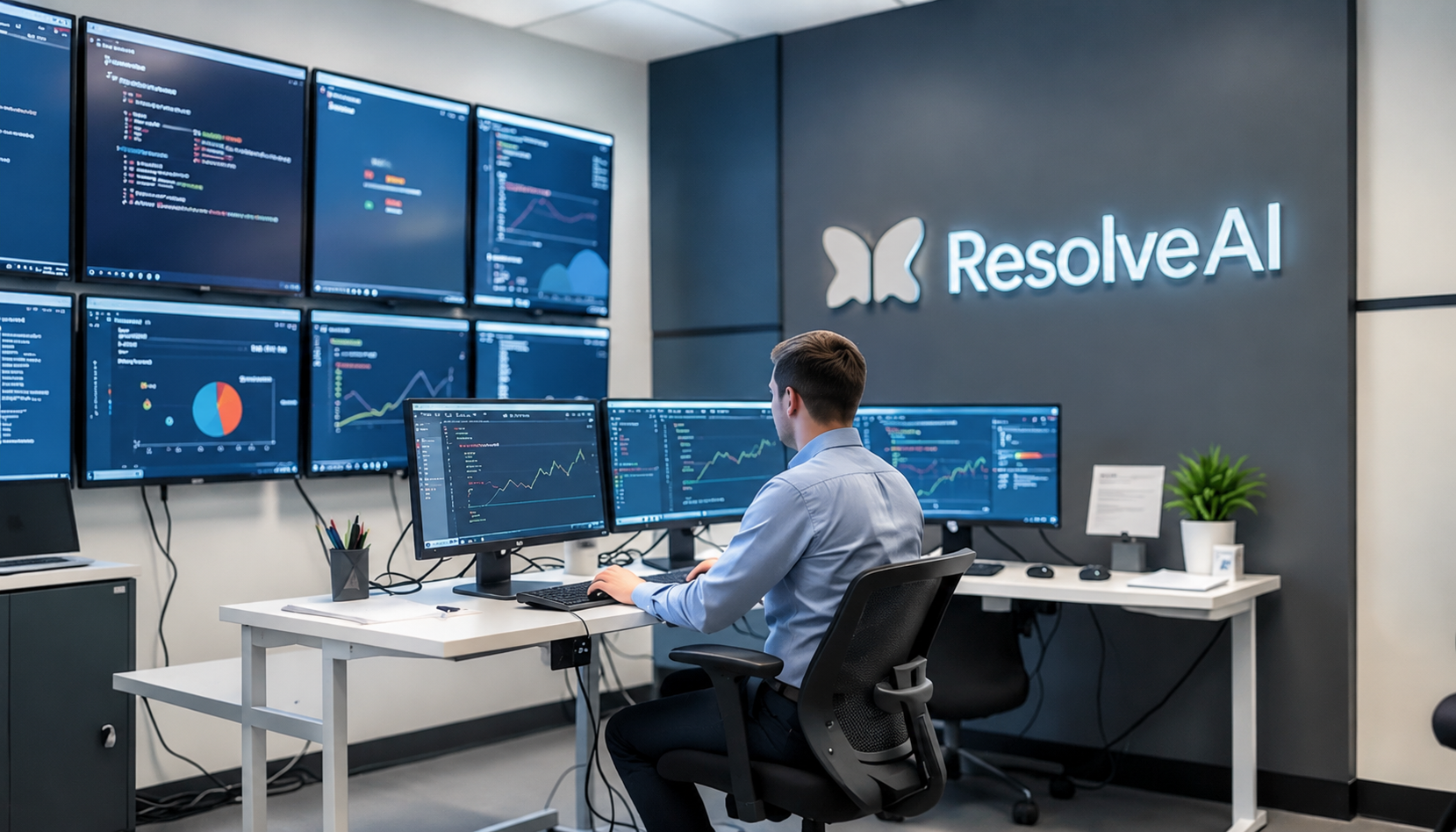
Incident remediation startup Resolve AI Inc. has announced the commercial availability of SRE-1, a specialized 27 billion-parameter open-weight model trained to diagnose the root causes of production alerts, alongside a new automated service designed to place artificial intelligence agents on call ahead of human engineers. The announcement highlights an ongoing shift in enterprise technology, where generative artificial intelligence is moving beyond software development and into live operational infrastructure.
Training Specialized Models for Production Operations
According to Resolve AI, while artificial intelligence has drastically accelerated how code is written, it has historically lacked direct integration into how software runs in production environments. Unlike published source code, which provides a massive public training corpus for general-purpose coding models, production incidents and operational telemetry remain strictly private to each enterprise. To address this gap, a team of 16 AI researchers spent 7.4 days utilizing up to 512 graphics processing units to train SRE-1 using reinforcement learning alone.
The company developed SRE-1 by leveraging Snowflake Inc.’s Cortex Training, a serverless service designed for customizing open-weight models. Snowflake Senior Vice President of Engineering Vivek Raghunathan noted that Resolve AI served as the initial design partner for the serverless customization platform. In benchmark evaluations involving difficult live production cases, an ensemble of five SRE-1 investigations matched the performance of leading frontier models at a significantly lower operational cost. Furthermore, when tested across 178 production alert investigations, the complete system successfully resolved approximately twice as many incidents as standard general-purpose coding agents.
Deploying Autonomous Agents on the Critical Path
The newly launched Primary On-call service puts this technology directly into daily enterprise operations. When a production alert is triggered, the AI agent conducts a comprehensive investigation across telemetry, infrastructure, application code, and operational knowledge bases. Depending on the findings and predefined team policies, the agent can autonomously close the alert, execute approved mitigations, or escalate the issue to human engineers. Following any intervention, the agent monitors the recovery process against the established production baseline and groups related alerts into a unified view.
To ease adoption for engineering teams hesitant to grant autonomous access immediately, Resolve AI provides a shadow mode that records the actions the agent would have taken on incoming pages. Company data indicates that Primary On-call can handle up to 80% of paged production alerts without human escalation. Early enterprise users, including Salesforce Inc., have reported substantial operational gains. Bhupesh Patel, a software engineering principal architect at Salesforce, stated that dark launch testing allowed the agent to close more than 70% of the CRM Analytics team’s paging alerts without waking human staff.
Industry Context and Future Outlook
Resolve AI Chief Executive Spiros Xanthos emphasized that modern engineering teams cannot keep pace with the velocity of code deployments and updates in production environments. The company’s solution aims to bridge this operational divide with automated agents capable of operating reliably on the critical path. Backed by more than $190 million in venture capital funding—including a $40 million Series A extension led by DST Global and Salesforce Ventures that valued the startup at $1.5 billion—Resolve AI counts major enterprises such as Coinbase Global Inc., DoorDash Inc., Figma Inc., MSCI Inc., Nasdaq Inc., SAP SE, and Zscaler Inc. among its prominent customers.
While access to the foundational SRE-1 model remains confined within Resolve AI’s proprietary platform, the general availability of Primary On-call marks a significant milestone for autonomous IT operations. As enterprises increasingly automate complex troubleshooting workflows, the success of specialized production models will likely shape how organizations manage uptime and incident response in highly distributed cloud environments.