

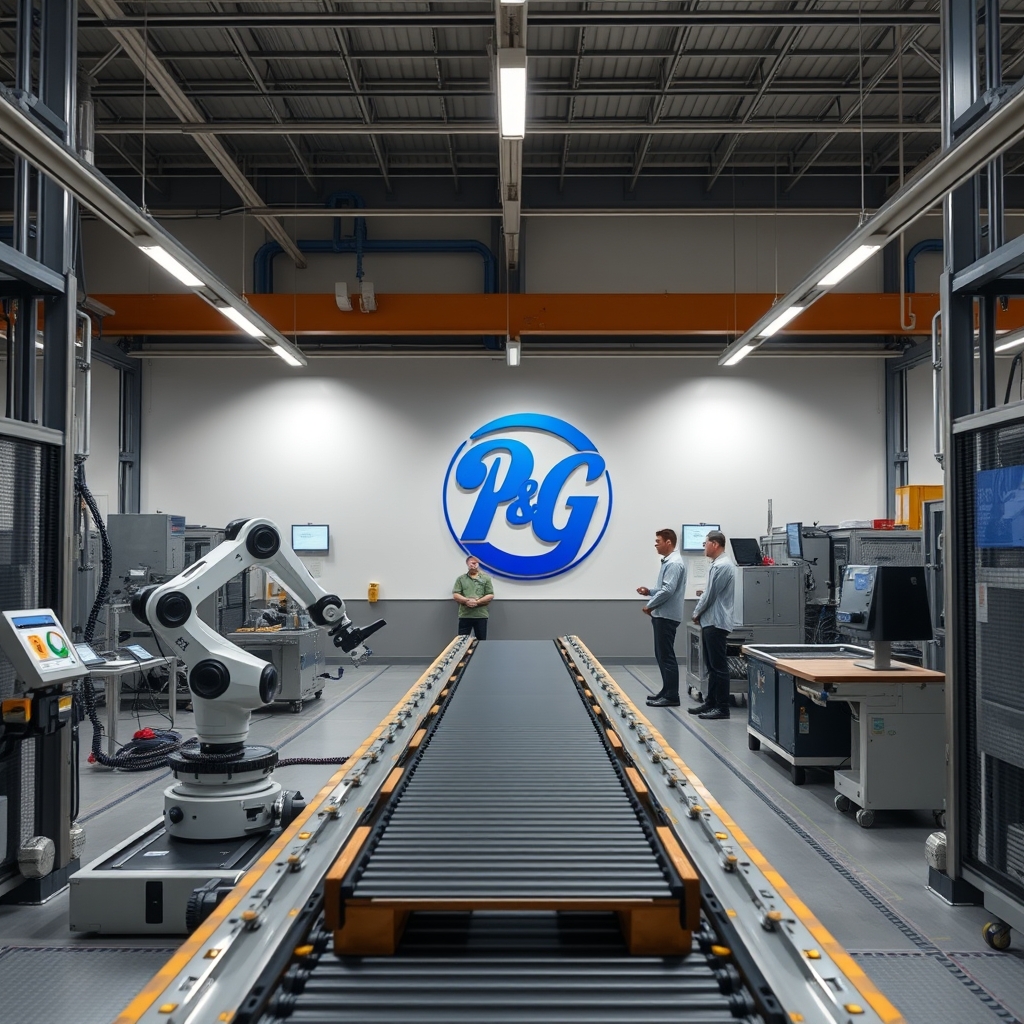
Procter & Gamble expects to reduce its product-supply workforce by as much as 30% by 2030 as automation expands across its operations, according to Supply Chain Dive. The plan links a significant potential reduction in staffing to a broader shift toward automated work, but the reported details do not establish how many roles would be affected or which parts of the supply chain would see changes. The 30% figure is an upper limit, not a confirmed final reduction, and the stated target year leaves several years for the company’s plans to develop.
The announcement concerns P&G’s product-supply headcount, a workforce category tied to making and moving goods through the company’s supply chain. It is not a stated reduction across the company as a whole. The report does not provide a baseline headcount, a breakdown by job type or location, or a schedule for individual workforce changes. Without those details, the headline percentage signals the scale of the intended change but cannot be translated into a specific number of employees or a precise account of how the work will be reorganized.
Automation and the shape of the plan
Automation can change the amount and kind of human labor required in supply-chain operations. In manufacturing and distribution more broadly, automated equipment may perform or assist with repeatable physical tasks, while employees remain responsible for work such as oversight, exception handling, maintenance and coordination. Those are general features of automation, not a description of specific P&G systems. The information available here does not identify particular technologies, facilities or processes involved in the company’s plan, so it would be premature to assume where automation will be deployed or which tasks it will replace.
The distinction matters because a workforce target does not, by itself, explain the path to achieving it. Companies can change staffing through a combination of redesigned jobs, attrition, reassignment and direct reductions, but the report does not say which approaches P&G intends to use. Nor does it describe how the company will sequence automation investments alongside staffing changes. The stated connection is that workforce reductions are expected as automation expands; details about implementation and employee support remain outside the information reported.
Workforce planning becomes an operational issue
For human-resources teams, a shift of this scale raises questions across the employee lifecycle, from workforce planning and skills development to internal moves and departures. If job requirements change as equipment and processes change, employers need to understand which capabilities will remain important and where employees may need different training. Those are practical considerations for businesses pursuing automation, rather than confirmed elements of P&G’s program. The available account does not outline a retraining, redeployment or severance plan, and those measures should not be inferred from the workforce target alone.
Supply-chain leaders also face the challenge of managing operational continuity while roles and processes evolve. Automation projects involve decisions about equipment, workflows and employee responsibilities, and those decisions can affect how work is organized across connected operations. For employers, workforce planning and technology planning therefore need to be considered together: staffing assumptions influence how a process is designed, while changes to a process can alter the skills and staffing it requires. The report does not detail P&G’s internal planning, but the announced target makes that relationship central to understanding the change.
What the announcement does—and does not—show
For other consumer-goods businesses, P&G’s plan is a notable example of a company connecting automation with a long-term reduction in supply-chain staffing. It does not establish that other companies will make the same commitment, or that automation will produce identical workforce effects across the sector. Supply chains differ in their products, operating models and processes, so a percentage target at one company cannot be applied directly elsewhere. The more transferable lesson is that automation decisions can carry workforce consequences that companies must account for alongside operational objectives.
The coming years will determine how P&G translates its stated expectation into changes on the ground. The available information establishes the potential scale and the 2030 horizon, but leaves open the affected roles, locations, implementation timetable and support for employees. Those details will be important for judging how the plan balances automation with workforce needs. For now, the announcement is best understood as a forward-looking target—not evidence that the full reduction has already happened or that every affected job has been identified.