

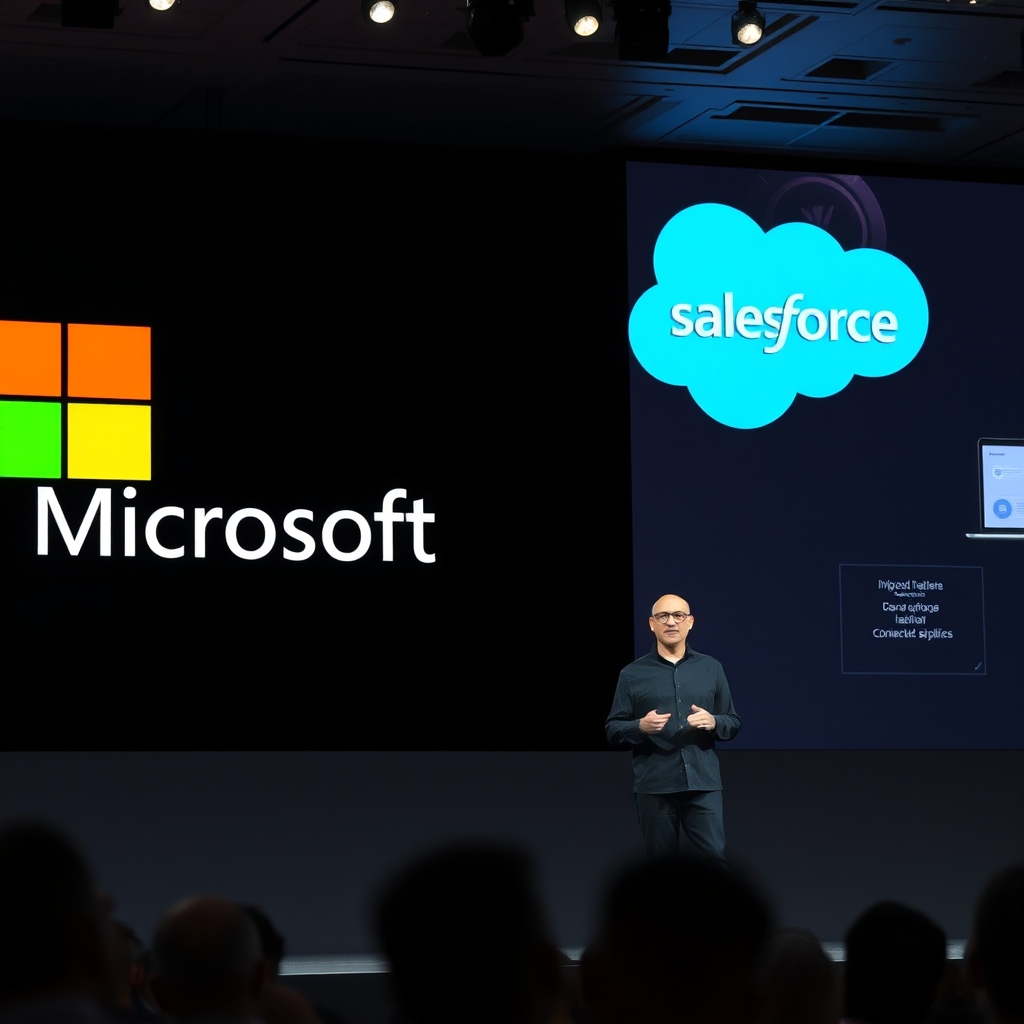
Salesforce and Microsoft are joining forces again, this time to connect Salesforce customer data and sales workflows with Microsoft Copilot and other Microsoft business tools. Announced at Microsoft’s Ignite conference, the integration—branded Copilotforce—puts Salesforce capabilities inside the environment where many employees already work, including Copilot and Microsoft Teams. The first release, Salesforce in Copilot, is available in public preview and includes more than 38 pre-built sales skills. The move marks a practical shift from the companies’ recent public sparring over AI toward closer product interoperability, while leaving questions about adoption and results to be answered by customers.
Salesforce workflows come to Microsoft’s work surfaces
The companies say the integrations bring customer context and Salesforce workflows together with conversations, meetings and documents in Microsoft 365. Salesforce in Copilot is described as a plugin that lets employees draw on Salesforce data, workflows, agents and pre-built skills through Copilot. The stated aim is to reduce the need to move between applications and help users act on customer information in the flow of work. The announcement also covers integrations across Microsoft Teams and Microsoft Fabric, although the launch material does not provide detailed descriptions of every capability in those products.
Salesforce in Copilot is in public preview, not a generally available release. The package’s more than 38 pre-built sales skills are intended to connect sales processes with Microsoft’s productivity environment. The companies present Copilot as a common access point for business applications, with Salesforce providing customer context and workflows behind it. That framing makes the partnership relevant beyond a simple software connector: it reflects a contest over where employees begin work and how they reach the business systems that support it. The announcement does not establish how widely the preview will be adopted or quantify productivity gains.
Accenture is participating as a design and implementation partner and as a pilot customer. The consulting firm says it has deployed the integrations in its global sales organization. It has more than 740,000 people using Copilot and 55,000 Salesforce users, according to the announcement. Its involvement gives the collaboration a large enterprise testing ground, but does not by itself demonstrate outcomes for other organizations. Businesses evaluating the preview will still need to assess how the integration fits their own systems, permissions and sales processes.
A partnership against a history of rivalry
Microsoft CEO Satya Nadella highlighted the Salesforce partnership during his Ignite opening keynote, describing Copilot as a central interface for work and third-party business applications as part of its expanding ecosystem. He said Microsoft was organizing skills, connectors and plugins for specific roles, including sales, legal, finance and service. He also announced business plugins for Dynamics 365. The Salesforce integration therefore sits within a broader Microsoft effort to make Copilot a route into both Microsoft products and selected external systems, rather than a standalone assistant.
The renewed cooperation contrasts with a long and often contentious relationship between Microsoft and Salesforce. Relations improved after Nadella became Microsoft CEO, and he appeared at Salesforce’s Dreamforce conference. The companies later clashed over their competing interest in LinkedIn; Microsoft won the acquisition, while Salesforce filed antitrust complaints. A reported Microsoft approach to buy Salesforce was also rejected over the proposed price. More recently, Salesforce CEO Marc Benioff criticized Microsoft’s Copilot strategy, questioning its ability to deliver reliable enterprise AI and invoking Microsoft’s old assistant Clippy as a derisive comparison.
For Salesforce, the arrangement places its CRM workflows within a productivity environment that Microsoft describes as a major point of entry for employees. For Microsoft, connecting a leading CRM platform to Copilot could make its assistant more useful in sales settings where customer records and activity are central. In either case, the value depends on whether the integration provides relevant, permission-appropriate information and supports tasks users actually need to complete. The public-preview status means businesses should distinguish the companies’ intended benefits from demonstrated performance, and evaluate the available functionality against their security and operational requirements.
Interoperability is the immediate test
The announcement reflects a form of cooperation between competitors: Salesforce and Microsoft retain their own platforms while making selected capabilities work together. That is a meaningful change in tone after months of criticism, but it does not erase the firms’ competitive interests or settle the broader debate about which company should own the employee’s primary AI interface. The next measure will be how the preview develops, what capabilities become available, and whether customers find the connection useful in day-to-day sales work. For now, Copilotforce is a partnership and integration initiative—not evidence that the rivals have put their differences permanently aside.